
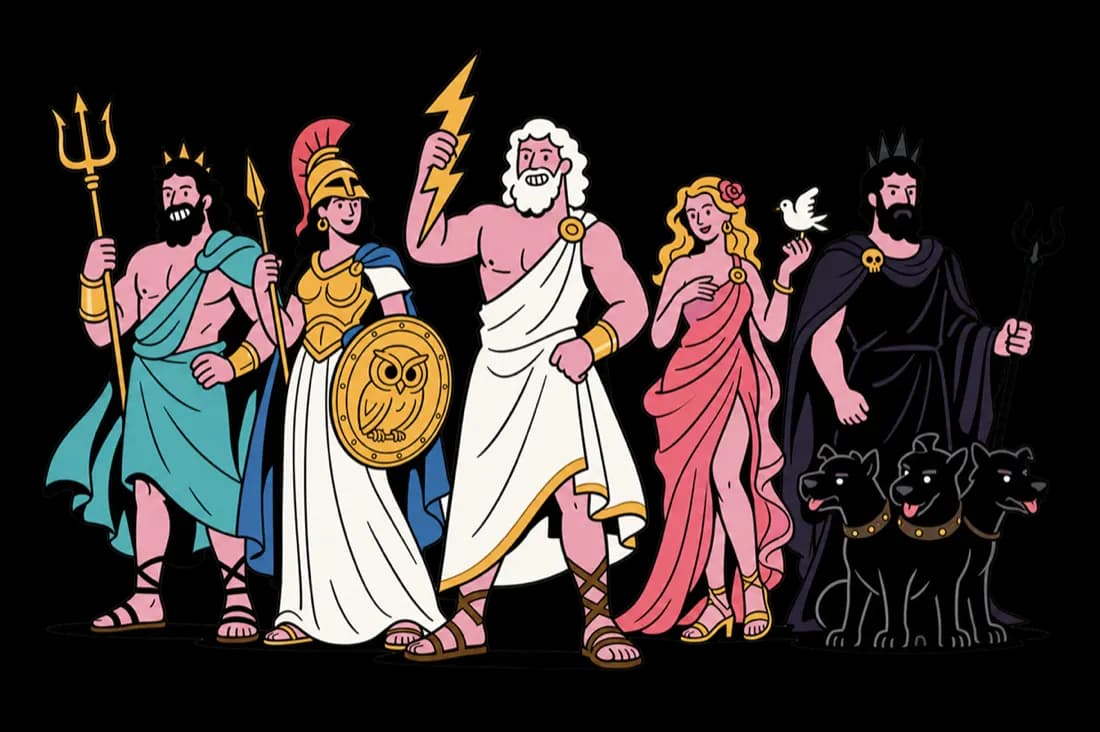

Greek God Quiz

Which Greek God Are You?

Explore the choices that shape your approach to power, wisdom, creativity, relationships, independence, and life's more complicated moments.

Step into the myth and follow your instincts.

Q1/ 9

You are invited to Olympus, but nobody tells you why. What do you do?

The PersonalitiesBehind the Myths

Greek mythology remains compelling because its gods and heroes are never defined by one simple quality. They lead and compete, create and destroy, protect their independence, form complicated relationships, and face consequences that cannot always be controlled.

Those stories also offer recognizable ways of thinking about human behavior. Zeus approaches uncertainty through responsibility and authority. Athena looks for the structure beneath a conflict. Apollo turns experience into expression. Aphrodite notices the emotional currents connecting people. Artemis protects autonomy and instinct. Hades remains present with complexity, while Odysseus survives by adapting without losing sight of where he is going.

These figures come from different positions within Greek mythology. Zeus, Athena, Apollo, Aphrodite, Artemis, and Hades are deities, while Odysseus is a mortal hero known for intelligence, endurance, and his difficult journey home. Within this quiz, they are used as symbolic narrative archetypes rather than religious identities.

The questions place you in situations involving responsibility, judgment, creativity, closeness, personal boundaries, uncertainty, and change. Your result is based on the pattern across your choices, not on which mythological figure you already like best.

This independently developed quiz is designed for personal reflection and entertainment. Its results are interpretive and do not determine religious identity, spiritual authority, psychological health, or objective truth.

How Your MythicMatch Emerges

Choose the response that feels most natural, rather than the answer that sounds most impressive, heroic, or socially desirable.

The quiz considers six recurring dimensions: Leadership, Wisdom, Expression, Connection, Independence, and Depth.

Your answers reflect six broad tendencies:

  • Leadership
  • Wisdom
  • Expression
  • Connection
  • Independence
  • Depth

Some choices may show how readily you take responsibility. Others reflect how you solve problems, make yourself understood, relate to people, protect your boundaries, or handle complicated experiences. No single response determines your result.

Your full answer pattern is compared with the tendencies represented by the seven available mythological archetypes. You will receive a closest match, an identity description, and interpretations showing where particular traits strongly resonate or offer room for greater balance.

Your Greek MythologyArchetype

Your closest match reflects the style that appears most consistently across your answers.

Two results can share qualities such as leadership, intelligence, sensitivity, or independence while expressing them differently. Athena and Zeus can both guide others, for example, but Athena tends to lead through strategy and clarity, while Zeus is more inclined to accept visible responsibility and make the decisive call.

The Resourceful Wayfinder

Odysseus

Odysseus reflects resourcefulness, endurance, and the ability to preserve direction while circumstances keep changing. You may be someone who looks for another route when the obvious plan fails, using observation and practical intelligence instead of waiting for ideal conditions.

This adaptability does not mean that nothing matters to you. Your strongest choices are often guided by an internal destination, a value, promise, or purpose you want to protect even when the path becomes unfamiliar. The tension in this pattern is knowing when flexibility is useful and when too much adjustment begins to pull you away from what matters.

You may resonate with Odysseus when you survive difficult transitions by thinking laterally, carrying complexity, and continuing forward without pretending the journey has been simple.

An Odysseus match suggests that adaptability becomes your strength when it continues to serve a meaningful direction.

The Storm-Bearing Leader

Zeus

Zeus reflects responsibility, visible authority, and the willingness to act when a situation lacks direction. You may naturally step forward when decisions must be made, especially when a group needs structure, protection, or a clear next move.

Your leadership is not only about confidence. It may also involve carrying competing interests, anticipating consequences, and trying to hold a larger system together. That sense of responsibility can become demanding when you assume that every important choice must rest on your shoulders.

The Zeus pattern is strongest when authority is used to create stability rather than control. You may recognize yourself in the instinct to organize uncertainty, protect important bonds, and accept accountability for what happens next, even when the decision is complicated.

A Zeus match reflects leadership that is most effective when decisiveness, responsibility, and consideration for others work together.

The Clear-Minded Strategist

Athena

Athena reflects strategic wisdom, composed judgment, and a preference for understanding the structure beneath a difficult situation. You may instinctively look for patterns, leverage, and long-term consequences before deciding what should happen next.

You do not necessarily need to dominate a room to influence it. Your authority may come from preparation, reliable reasoning, and the ability to remain clear when other people feel overwhelmed. At times, however, your desire to make the strongest possible decision can turn into overanalysis or make your reasoning difficult for others to follow.

The Athena pattern combines independence with purposeful intelligence. You are likely to trust conclusions that make internal sense, but your judgment becomes even stronger when it can be tested, explained, and turned into action.

An Athena result suggests that your clearest strength lies in using thought, strategy, and self-directed judgment to create a workable path forward.

The Radiant Creator

Apollo

Apollo reflects expression, creativity, and the desire to make inner experience visible. You may be drawn to language, music, imagery, performance, design, or any medium that gives thoughts and feelings a recognizable form.

Your creativity is not necessarily impulsive. The Apollo pattern also values technique, observation, discipline, and attention to how an idea is shaped. You may want your work to be both personally meaningful and understandable to others.

This can create tension between expression and perfection. Waiting for the ideal form may keep an idea hidden, while seeking a strong response can make external recognition feel more important than the work itself. Your most satisfying expression often appears when craft supports curiosity rather than suppressing it.

An Apollo match points to a creative nature that connects inspiration with form, visibility, and shared meaning.

The Heartful Connector

Aphrodite

Aphrodite reflects emotional awareness, attraction, beauty, and the ability to recognize what creates closeness between people. You may notice subtle changes in tone, desire, presentation, and connection that others overlook.

This sensitivity can help people feel seen. You may understand that beauty is not merely decorative: a thoughtful gesture, atmosphere, or form of expression can communicate value when ordinary language falls short. You may also be comfortable acknowledging that affection, longing, loss, and uncertainty can exist together.

The challenge is maintaining your own direction while responding deeply to other people. Connection becomes less sustainable when you feel responsible for managing every emotion or shaping yourself around every reaction.

An Aphrodite result reflects relational and expressive sensitivity that is strongest when closeness does not require you to lose your own center.

The Self-Directed Guardian

Artemis

Artemis reflects autonomy, instinct, clear boundaries, and loyalty to a path that feels genuinely your own. You may be comfortable making choices without universal approval and prefer having enough space to recognize what you truly think.

Your independence is not necessarily rejection. It can be a way of protecting your attention, values, relationships, or chosen environment from expectations that do not fit. You may observe patiently before acting, then move with precision once the situation becomes clear.

This self-direction can become isolating when help is refused automatically or privacy becomes the only response to complicated emotions. The Artemis pattern becomes more flexible when trusted companionship can exist without threatening freedom.

An Artemis match suggests that independence, measured judgment, and strong internal boundaries shape how you protect what matters.

The Quiet Sovereign

Hades

Hades reflects depth, quiet authority, transformation, and the capacity to remain present with subjects that other people may prefer to avoid. You may be able to face endings, difficult emotions, or complicated truths without requiring them to become simple.

Your influence may be understated. Rather than seeking constant attention, you may create stability by understanding your domain, accepting responsibility for it, and setting firm conditions around what you value. Other people may feel steadier around you even when you say relatively little.

The difficulty is making your inner reasoning visible enough for others to understand how to approach you. Privacy and boundaries can protect your strength, but they may also create distance when no doorway is clearly offered.

A Hades result points to grounded depth and self-defined authority that become most constructive when complexity can be shared without being overexposed.

Your MythicIdentity

Each result includes an identity that summarizes its most recognizable role within the quiz.

Odysseus is The Resourceful Wayfinder, Zeus is The Storm-Bearing Leader, Athena is The Clear-Minded Strategist, Apollo is The Radiant Creator, Aphrodite is The Heartful Connector, Artemis is The Self-Directed Guardian, and Hades is The Quiet Sovereign.

Your identity highlights a recurring pattern in your answers. It does not describe every part of your personality, and it does not make you the deity or hero whose name appears in the result.

  • 01The Resourceful Wayfinder
  • 02The Storm-Bearing Leader
  • 03The Clear-Minded Strategist
  • 04The Radiant Creator
  • 05The Heartful Connector
  • 06The Self-Directed Guardian
  • 07The Quiet Sovereign

Where Your TraitsStrongly Resonate

Your result explores three trait combinations associated with your closest mythological archetype.

A Strong Resonance interpretation means that a particular pattern appeared clearly across your responses. Depending on the result, this might involve taking charge during uncertainty, recognizing the strategy inside a conflict, turning emotion into expression, making others feel seen, protecting your own path, carrying difficult truths, or finding a new route when a plan collapses.

These patterns are not ranked. Leadership is not more valuable than connection, independence is not more mature than cooperation, and depth does not imply greater wisdom or spiritual awareness.

Strong Resonance simply describes where the relationship between your answers and the result archetype is most visible.

Where Your ArchetypeFinds Balance

Growth interpretations appear when a trait is less strongly expressed in your current answers. Growth does not mean that you lack the trait or have failed to embody your result.

Instead, it considers how a useful quality might become more flexible. Leadership may grow by allowing consultation. Wisdom may need a point at which analysis becomes action. Expression may benefit from sharing work before it feels perfect. Connection may need clearer emotional boundaries. Independence may become less solitary, while depth may become easier to communicate.

Odysseus may need to distinguish adaptation from abandoning direction. Zeus may need to share responsibility. Athena may need to make her reasoning accessible. Apollo may need to protect creative play. Aphrodite may need to care without managing every response. Artemis may need to accept chosen companionship. Hades may need to show trusted people where they are welcome.

Growth is presented as balance, not correction or judgment.

Who Is This
Quiz For?

This quiz may appeal to people who are:

  • 01People wondering, "Which Greek god are you most like?"
  • 02Readers interested in Greek gods, heroes, and mythology archetypes.
  • 03Anyone curious about how they approach power, wisdom, creativity, and connection.
  • 04People exploring independence, boundaries, resilience, or emotional depth.
  • 05Users looking for a personality-based quiz rather than a mythology knowledge test.
  • 06Anyone who wants a reflective result without treating it as a clinical or religious assessment.

Why Take the Quiz?

01

Free to Start

You can begin the Greek God Test without payment and respond at your own pace.

02

Shaped by Your Choices

Your match comes from the pattern across your answers. It is not a random god generator and is not determined by choosing a favorite deity.

03

More Than a Result Name

Your result includes a mythic identity and interpretations of Strong Resonance and Growth across three relevant trait themes.

04

Simple to Complete

Choose the response that most closely reflects what you would naturally do. You do not need to study Greek mythology, memorize the gods' symbols, or select the answer that appears most heroic.

What YourResult Means

This is a mythology-themed self-discovery quiz. It compares your answer pattern with seven available archetypes and identifies the result that most closely reflects the tendencies you expressed during the experience.

The match does not mean that you literally are, represent, worship, or have been selected by a Greek deity. Six results are based on mythological gods and goddesses, while Odysseus represents a heroic archetype shaped by resourcefulness, endurance, and the effort to return home.

Results can overlap. Zeus and Hades may both show leadership, but Zeus tends to express it through visible responsibility while Hades represents quieter authority. Athena and Artemis may both rely on independent judgment, but Athena emphasizes strategy while Artemis places greater weight on autonomy, instinct, and timing. Apollo and Aphrodite may both value beauty and expression, but Apollo gives inner experience a crafted form while Aphrodite focuses more strongly on emotional connection and desire.

Your answers may change as your circumstances, priorities, or interpretation of the questions change. You may also relate to more than one result. The closest match is a starting point for reflection, not a complete or permanent personality classification.

This quiz is independently developed by Tranquil for personal reflection and entertainment. Its results are interpretive and do not determine a person's complete personality, psychological condition, religious identity, spiritual authority, cultural identity, future, destiny, or objective truth.

The names, stories, symbols, deities, and heroes discussed in this quiz originate in the historical religious, literary, and cultural traditions of ancient Greece. Tranquil does not claim ownership of those traditions or represent any religious organization, cultural institution, scholarly authority, or traditional community.

?Greek God Test Questions
What type of Greek god am I?

Your closest match depends on how you respond to situations involving responsibility, judgment, creativity, emotional connection, personal freedom, and complexity. The available deity results are Zeus, Athena, Apollo, Aphrodite, Artemis, and Hades. Odysseus is also included as a Greek heroic archetype centered on resourcefulness and endurance. For a broader introduction to the gods and their traditional domains, explore Greek Gods and Goddesses: Names, Powers and Domains.

How does the Greek God Test choose my result?

The quiz considers the overall pattern across your answers. Choices may reflect Leadership, Wisdom, Expression, Connection, Independence, or Depth, and your combined tendencies are compared with the seven available result profiles. One answer cannot select a result by itself. The quiz looks for the closest fit across multiple choices rather than asking which deity you already prefer.

Which results can I get?

You can match with Odysseus, Zeus, Athena, Apollo, Aphrodite, Artemis, or Hades. Each result represents a different combination of tendencies. Odysseus emphasizes adaptability and direction; Zeus, responsibility and authority; Athena, strategy and judgment; Apollo, expression and creativity; Aphrodite, connection and sensitivity; Artemis, independence and boundaries; and Hades, complexity and quiet authority.

What do Greek god symbols mean?

Greek deities are traditionally associated with recognizable objects, animals, plants, and natural forces. Zeus is commonly connected with the thunderbolt, Athena with the owl and olive tree, Apollo with the lyre and laurel, and Artemis with the bow and deer. These symbols reflect aspects of their mythological roles rather than providing a method for objectively identifying someone's personality. You can explore these associations in Greek Gods Symbols and Their Meanings.

Is Odysseus a Greek god?

No. Odysseus is a mortal hero in Greek mythology, not a god. He is included because his long journey, strategic thinking, adaptability, and determination provide a distinct narrative archetype. Within this quiz, an Odysseus match represents a resourceful way of responding to obstacles. It does not change his position in the original mythology or place him among the Olympian gods.

What can Greek myths reveal about personality?

Greek myths portray figures making choices under pressure, power, desire, conflict, uncertainty, and loss. Modern readers can use those stories as symbolic prompts for considering recognizable human tendencies, provided the interpretations are not treated as clinical conclusions or objective personality facts. To explore the stories behind these figures, see Greek God Stories: Famous Myths and Their Meanings.

Can I relate to more than one Greek god archetype?

Yes. The archetypes share several qualities, and people rarely express only one style. You might relate to both Athena's strategic judgment and Artemis's independence, or to Apollo's creativity and Aphrodite's sensitivity to beauty and connection. The quiz provides the closest available match based on your complete answer pattern, not a claim that every other result is irrelevant.

Can my Greek God Test result change?

It can. Your result reflects the answers you give during a particular attempt. Changes in priorities, circumstances, self-understanding, or interpretation of a question may produce a different pattern later. A changing result does not mean that one attempt was false. It can simply show that no short quiz captures every aspect of a person permanently.

Is this a scientific personality test?

No. The Greek God Test is not a validated psychological assessment, clinical instrument, diagnostic tool, or substitute for professional guidance. It uses mythological archetypes as a structured form of reflection and entertainment. The result can help you consider patterns in your choices, but it should not be treated as scientific proof about your personality or mental health.

Is the Greek God Test connected to religion?

The quiz draws on names and narrative figures from ancient Greek religious, literary, and cultural traditions, but it does not assess belief or determine religious identity. You do not need to practice a religion or hold spiritual beliefs to take it. Receiving Zeus, Athena, Apollo, Aphrodite, Artemis, Hades, or Odysseus as a result is a symbolic match within this experience, not a religious designation, divine message, or spiritual calling.