D&D Class Quiz

What D&D Class Am I?

Every adventuring party needs a different kind of strength. Follow your instincts through danger, mystery, and difficult choices to find the fantasy class archetype closest to you.

Your party is waiting. Choose how you enter the story.

Q1/ 9

Your party reaches a locked gate at sunset. You...

Where EveryAdventure Begins

A fantasy adventure rarely begins with a complete map, a sensible plan, and a party that agrees on what to do next.

It begins with an unopened door, an uncertain road, a warning that arrives too late, or a problem that suddenly belongs to everyone. What makes role-playing adventures compelling is not only the creatures, magic, or treasure beyond that point. It is the way different adventurers respond when the outcome is unknown.

One person steps forward before fear has settled. Another studies the room for the route everyone missed. Someone searches old knowledge for the rule beneath the mystery, while another keeps the group anchored to a shared purpose. A careful observer reads the terrain, and a natural storyteller finds the words that help everyone continue.

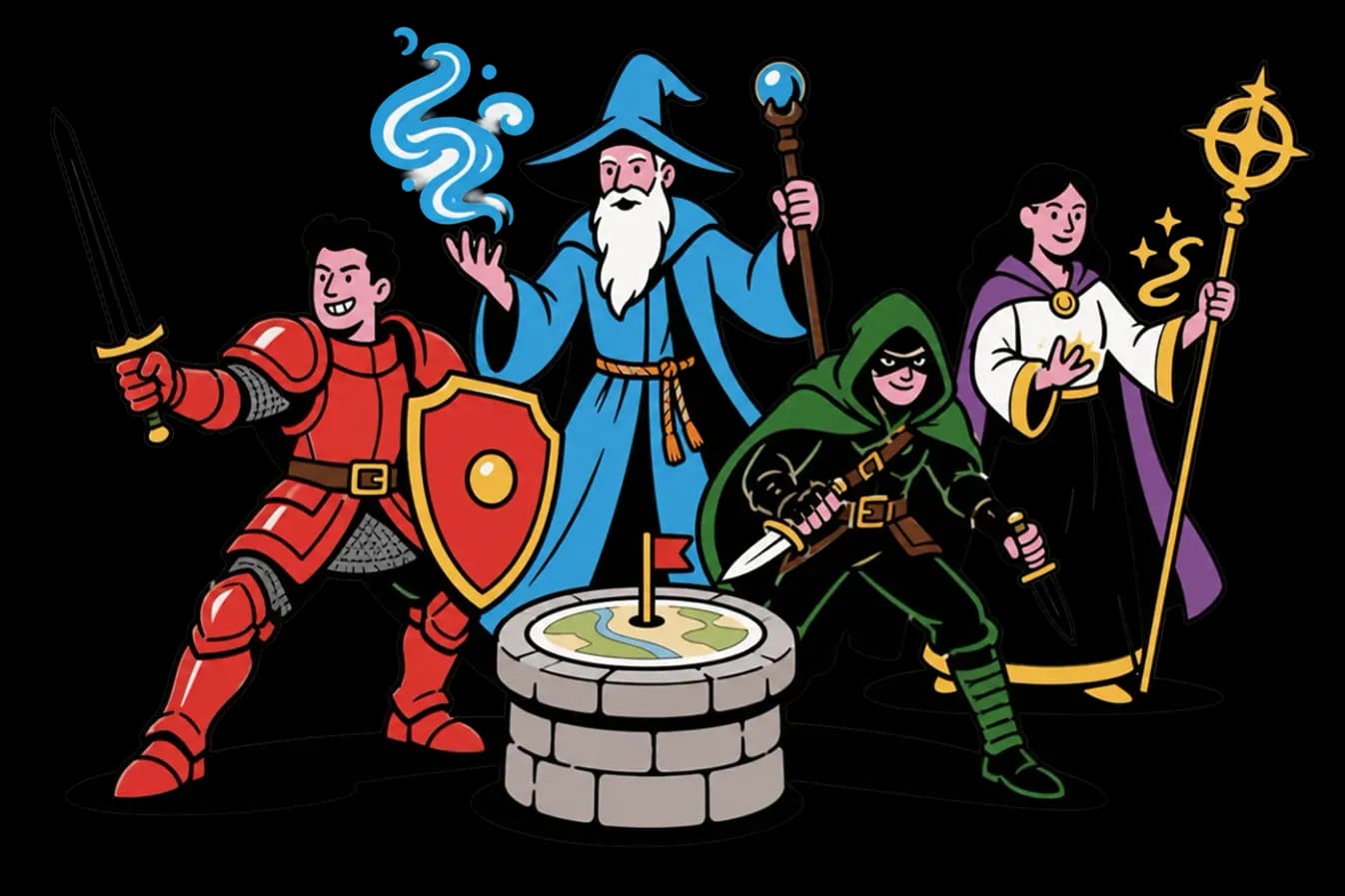
These differences are what give an adventuring party its character. A Fighter, Rogue, Wizard, Cleric, Ranger, and Bard can all be courageous, intelligent, or loyal, but they express those qualities through different choices.

The Tranquil D&D Class Quiz explores the broad fantasy archetype behind your way of acting, solving problems, protecting others, and creating connection. It looks at your overall answer pattern rather than your favorite class, your knowledge of game rules, or the build you currently play.

This is an independently developed, unofficial fantasy class quiz created by Tranquil. It is not produced, sponsored, endorsed, approved, or authorized by Wizards of the Coast LLC or any associated rights holder.

How Your ClassTakes Shape

You will make choices inspired by the situations that define a fantasy adventure: a threat that requires action, a blocked route, an unexplained pattern, a vulnerable companion, an unfamiliar landscape, or a party beginning to lose heart.

Choose the response that feels most natural, not the option that sounds most impressive once the danger has safely passed.

Your answers reflect six broad tendencies:

  • Courage
  • Ingenuity
  • Knowledge
  • Devotion
  • Instinct
  • Expression

The quiz considers how these qualities appear together across several situations. One answer cannot determine your class, and the result is not selected randomly.

You will receive a primary class archetype, its identity, three trait interpretations, and supporting second and third matches.

Your FantasyClass Match

If you joined an adventuring party, what would everyone learn about you once the plan stopped working?

You might become the person who takes the dangerous position, notices an overlooked escape, understands the hidden system, protects the party's purpose, reads the path ahead, or reminds everyone why the quest remains worth completing.

Your result matches your answer pattern with one of six fantasy class archetypes.

The Frontline Anchor

Fighter

A Fighter moves toward the moment that requires someone to act. Courage is not merely an idea to them; it becomes a practical decision, a visible commitment, or a position taken so that someone else has room to move.

Their strength comes from reliability as much as force. They follow through when pressure rises and bring order to confusion through useful action. That protective instinct can make them a natural anchor for a group, but it may also encourage them to carry too much or move before the whole situation is clear.

A Fighter match suggests dependable courage, protective action, and a willingness to step forward when waiting has become its own risk.

The Clever Pathfinder

Rogue

A Rogue sees more than the obvious route. When the expected solution fails, they look for openings, alternate uses for available resources, and details that everyone else moved past too quickly.

Their intelligence is agile rather than purely theoretical. They are comfortable improvising with incomplete information and can turn an obstacle into a puzzle that has not yet been solved. Strong instincts help them sense when to pause, question, move, or change direction. However, flexibility can become endless analysis if every possibility remains open for too long.

A Rogue match points to clever adaptability, precise instinct, and an ability to find the next possible move when the obvious path closes.

The Curious Strategist

Wizard

A Wizard wants to understand why the mystery works. Knowledge is not collected only for its own sake; it becomes a resource that reveals new options, explains hidden patterns, and changes what the party believes is possible.

Their strength lies in structured curiosity. They trace causes, compare evidence, test ideas, and look beneath surface explanations for the rule connecting the pieces. This makes them calm and useful in complicated situations. Yet the desire to understand everything can delay action, while an elegant theory has limited value until it is applied.

A Wizard result reflects investigative knowledge, strategic curiosity, and a tendency to turn understanding into new possibilities for the whole party.

The Purposeful Guardian

Cleric

A Cleric acts from purpose. They consider not only whether something can be done, but whom it affects, what deserves protection, and which values should guide the party when convenience is no longer enough.

Their care is practical rather than abstract. They notice who needs support, remain present when morale weakens, and help people remember that difficulty does not have to be faced alone. This devotion can give a group direction and hope. It can also leave Clerics waiting for the perfect answer or assuming that responsibility for everyone's well-being rests entirely with them.

A Cleric match suggests purposeful care, steady devotion, and an instinct to protect both the people in the party and the reason they continue.

The Wilds Navigator

Ranger

A Ranger reads the world before deciding how to move through it. They notice changes in terrain, atmosphere, resources, and risk, gathering information through attention rather than noise.

Their courage is grounded and adaptive. An incomplete map does not necessarily stop them; they search for the next landmark, the safest useful direction, or the sign that reveals what the environment is already saying. Rangers also think about whether a journey can remain sustainable, not only whether it can begin.

A Ranger match reflects environmental awareness, practical instinct, and a talent for helping others move through unfamiliar territory without ignoring its risks.

The Spirit Lifter

Bard

A Bard understands that a party needs shared spirit as much as individual ability. Through conversation, imagination, humor, story, or sincere encouragement, they help people feel connected to one another and to the reason the journey matters.

Their expression creates emotional momentum. They can find language for hope without pretending the danger is smaller than it is, and they often help strangers become collaborators. Their challenge is trusting that expression does not need to be flawless or dramatic to matter; sometimes one honest sentence is enough.

A Bard result suggests expressive courage, social adaptability, and an ability to turn individual travellers into a party with a shared sense of purpose.

Your AdventuringClass Identity

Your result includes an identity connected with the role you would most naturally occupy within a fantasy party. This identity highlights the qualities that become most visible when the group encounters danger, uncertainty, or a difficult choice. It does not claim to describe every part of your personality.

Your result also includes second and third matches. These represent supporting strengths within your adventuring style, not weaker versions of your primary class.

  • 01The Frontline Anchor
  • 02The Clever Pathfinder
  • 03The Curious Strategist
  • 04The Purposeful Guardian
  • 05The Wilds Navigator
  • 06The Spirit Lifter

Your StrongestAdventuring Traits

Each result explores three qualities that create the strongest connection between your choices and your primary class.

A Strong Resonance interpretation means that a quality already appears clearly across your answers. Depending on your result, this could involve acting while fear is still present, finding an alternative route, turning knowledge into a useful possibility, protecting people through visible care, reading changes in the environment, or creating courage through expression.

The interpretation explains how the trait may shape the way you approach problems, work with other people, and respond when the next step is uncertain.

Where Your ClassCan Grow

A Growth interpretation does not mean that you lack a trait. It shows where a quality may become more flexible, useful, or sustainable.

Courage can benefit from awareness of the whole group. Ingenuity may need a decision before every possibility has been explored. Knowledge becomes stronger when it enters action, while devotion must leave room for shared responsibility. Instinct benefits from evidence, and expression becomes more powerful when it is allowed to be sincere rather than perfect.

A strong adventuring style is not a fixed role. It is a set of tendencies that can expand as the journey asks more of you.

Who Is This
Quiz For?

This quiz may appeal to people who are:

  • 01Wondering what D&D class they are.
  • 02Curious whether they resemble a Fighter, Rogue, Wizard, Cleric, Ranger, or Bard.
  • 03Looking for a D&D class quiz based on meaningful choices rather than trivia.
  • 04Interested in fantasy classes, adventuring roles, and storytelling archetypes.
  • 05Choosing a starting direction for a new fantasy character concept.
  • 06Interested in how they act, solve problems, protect others, and create connection.

Why Take the Quiz?

01

Free to Start

You can begin without payment and move directly into the adventure choices. No quest notice, tavern introduction, or conveniently available prophecy is required.

02

Shaped by Your Choices

Your primary class reflects the overall pattern across your answers rather than a random draw. The quiz considers how you respond to danger, obstacles, mysteries, responsibility, unfamiliar environments, and the emotional needs of a group.

03

More Than a Class Name

Your result includes a primary fantasy class archetype, your adventuring identity, three class-related trait interpretations, Strong Resonance or Growth readings, and supporting second and third matches.

04

Simple to Complete

Choose the answer that feels closest to your natural response. You do not need to understand character optimization, memorize a spell list, or know which rule applies to opening a suspicious dungeon door.

What YourResult Means

The D&D Class Quiz is a fictional fantasy-archetype personality quiz created for character inspiration, imaginative identification, and personal reflection.

Your primary result represents the available class archetype whose overall pattern most closely resembles your choices. It does not mean that you possess every quality associated with that class or that you should always play it in a tabletop campaign.

You may resonate with several classes. A Fighter and Cleric can both protect a group, but the Fighter usually expresses protection through immediate action while the Cleric connects it with care and purpose. A Rogue and Ranger can both rely on awareness, but the Rogue searches for an unexpected opening while the Ranger reads the wider environment for direction.

Wizard and Bard both create possibilities. The Wizard tends to do so through knowledge and pattern recognition, while the Bard works through expression, imagination, and human connection. The quiz considers the complete combination rather than assigning a class from one shared trait.

Your second and third matches show supporting strengths within your adventuring style. They are not inferior results, and they do not suggest that your primary class defines your entire personality.

This result is not an official Dungeons & Dragons classification, character-building recommendation, rules assessment, psychological diagnosis, clinical test, scientifically validated personality assessment, or substitute for MBTI or another personality framework.

Dungeons & Dragons, D&D, D&D Beyond, associated settings, names, stories, artwork, logos, trademarks, and other protected elements belong to Wizards of the Coast LLC, its affiliates, licensors, or their respective rights holders. Tranquil does not claim ownership of the original intellectual property.

Tranquil is not affiliated with, produced by, sponsored by, endorsed by, approved by, or authorized by Wizards of the Coast LLC, Hasbro, D&D Beyond, or any associated rights holder.

?D&D Class Questions
What D&D class am I?

Your closest class depends on how you approach danger, uncertainty, knowledge, responsibility, observation, and expression. You may resemble a Fighter's dependable courage, a Rogue's adaptable ingenuity, a Wizard's structured curiosity, a Cleric's protective devotion, a Ranger's environmental instinct, or a Bard's connective expression. For a broader overview, explore D&D Classes Explained: Roles, Playstyles and Subclasses.

How does the D&D class quiz choose my result?

The quiz compares the pattern across all your answers with six available fantasy class archetypes. Your choices reflect Courage, Ingenuity, Knowledge, Devotion, Instinct, and Expression. One answer cannot determine the outcome, and the result is not selected randomly. You also receive second and third matches that show supporting tendencies within your broader adventuring style.

Which classes can I get?

The current results are Fighter, Rogue, Wizard, Cleric, Ranger, and Bard. These six classes represent distinct ways of contributing to an adventure. The quiz does not currently include every class available across official Dungeons & Dragons rules. Compare their broader roles in D&D Classes Explained: Roles, Playstyles and Subclasses.

Which D&D class should I play?

The class you enjoy playing may depend on your preferred mechanics, campaign, party composition, and the kinds of moments you want to experience. This quiz can provide a character-concept starting point, but it does not replace reading the rules or discussing options with your Dungeon Master. Use Which D&D Class Should You Play? to compare practical playstyle considerations.

What is the difference between a class and a subclass?

A class provides a character's broad ability framework, central fantasy, and common role within an adventuring party. A subclass develops a more specialized path within that larger foundation. This quiz matches only broad class archetypes. The distinction is explained in D&D Classes Explained: Roles, Playstyles and Subclasses.

Can I resemble more than one class?

Yes. The classes are not completely separate personality categories. You may combine Fighter courage with Cleric devotion, Rogue ingenuity with Ranger instinct, or Wizard knowledge with Bard expression. Your primary result represents the closest overall pattern, while your second and third matches show additional strengths that may also shape your adventuring style.

Can I retake the D&D class quiz?

Yes. You may receive a different result if you change several answers or respond from another genuine side of your personality. Retaking can be useful when your first answers reflected the class you hoped to receive rather than what you would naturally do.

Is this an official D&D class quiz?

No. This is an independently developed, unofficial fantasy class-archetype quiz created by Tranquil. It is not produced, sponsored, endorsed, approved, or authorized by Wizards of the Coast LLC, Hasbro, D&D Beyond, or any associated rights holder. It does not assess official rules knowledge, generate a character build, or determine which class you should use in a campaign.

Is this a psychological personality test?

No. The result is not a psychological diagnosis, clinical test, scientifically validated assessment, or substitute for an established personality framework. The six dimensions create an imaginative fantasy-class match for reflection or character inspiration; they cannot define your complete personality or measure mental health.